
The book of Job begins by telling us about the righteous man Job whom God had blessed abundantly (and is probably King Jobab mentioned in Genesis). Then we are told about the devil, who roams about the earth, approaching God and asking for someone to attack. God proposes Job, whom He has confidence in. On the other hand, Satan believes Job will forsake God when all of his blessings are taken away (because the devil assumes everyone is like himself). Job’s livestock and all his children are lost to strange accidents, and he eventually becomes very sick too. His wife tells him to curse God and die, which he refuses, and then he has multiple friends (probably royal advisors) who come, and basically argue that what has happened has happened because Job must have sinned greatly. Job protests and argues with these friends for most of the book, and finally God shows up in the end, giving a stern talk to Job but also praising him for speaking rightly while condemning the friends for speaking wrongly. Job is overjoyed at his encounter with God, and God blesses him with even more riches than he had before.
++++++++++
While Satan has free will and is doing evil from his own choice, God is allowing what Satan is doing because of His own purposes. We see in Job that Satan must ask permission from God to cause trouble, and that God actually points out His servant Job for Satan to go after. Satan is actually a tool in God’s toolkit to get His loving work done. Satan’s pride blinds him to this. It is very plausible that Leviathan mentioned in the story who God claims is his pet is actually the devil, doing God’s work without intending to.
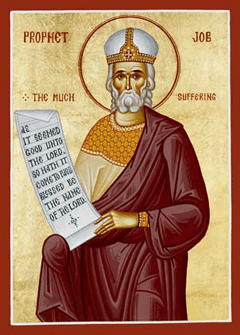
And what work is God doing? Theosis. Salvation. We often make the mistake of thinking that our suffering is a punishment for a bad deed we did, that if we had just made the right choice, we wouldn’t have had to suffer. But this is a human misunderstanding of sin, that it is simply a trespass. In reality, sin is a state of the heart that is a sickness, and sins as violations of the law are symptoms of this illness, like how a virus produces a cough. We are pointed to the sins so we know about our sick heart, as a doctor points to a cough to reveal a virus. This sickness is the natural result of the Fall, of man’s eviction of God from His heart in an attempt to be god all on his own.
And what is the medicine for this illness of the heart? It is to be born again, to be returned to dirt (humus) so that we can be re-created, to acquire humility, to experience humiliation (these are all three the same root word). Our hearts are meant to be soft soil for the Holy Spirit to be planted in, and instead they are like hard soil that will not accept the Sower’s seed. The Crosses that God sends are the threshing that softens the soil to prepare it for the arrival of the King, and with Him all His inheritance: love, joy, peace, hope, etc.
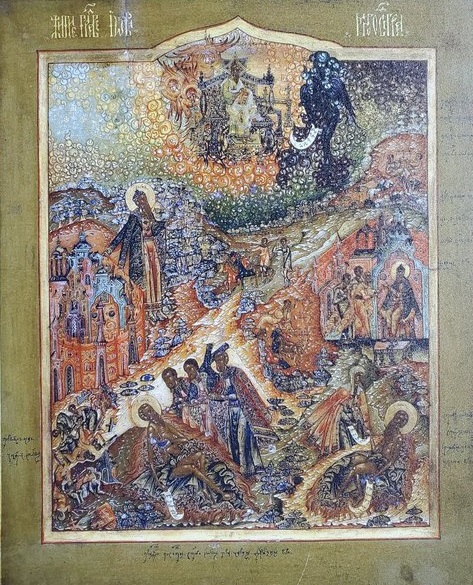
Job’s “friends” argue from what is today called the prosperity Gospel, the same way our shame often argues, that if we are suffering we must have done some specific crime that God is punishing us for. They project their human egos onto God. But God is, in reality, a loving Father, who’s only interest is in healing man and entering into real intimacy with him, which requires man to be healed from his illness of selfishness, and this comes for Job through a difficult trial which Satan sends to spite God, but God intends to use to heal His servant Job.
St Paisios says that God hates us suffering and can barely stand it. The reason He can bear it is He knows which of us will be genuinely thankful for it on the other side, similar to how St Paul says he can only bear suffering because He knows what’s on the other side. This is why many Saints like St. John Chrysostom say that the ultimate sign of God’s wrath and disfavor is actually when He DOENS’T send us suffering. The Saints say, contrary to Job’s companions, that it is actually suffering that is a sign of God’s favor. God says in a way “It is worth allowing the horror of these trials because in my providence I know that on the other side you and I will both truly rejoice in them together.” And not only this, but at the Cross God enters into these trials Himself, even though He is already pure and without this sickness, in order to be closer to us.
As Job has lost all his prosperity and even his health due to the evils of Satan, he questions God many times, whereas Job’s companions seemingly justify God. But the heart of Job’s questions, though out of weakness, are out of desire for God, out of friendship. (Job’s friends actually seek to justify themselves.) It is similar to what the hymns say of St Thomas the Apostle, that he had “holy doubt.” When Job’s friends try to explain his suffering, his response is basically “No, I know God, He’s not like that. I’m utterly confused what He’s up to, but I know He is good and not like that. I am just in such agony and cannot help but ask why.”

In the end, God shows up. What we read are words that sound rather dismissive but represent God coming in all His power and glory. “Who are YOU to question me when Leviathan is my PET?” But afterwards we don’t see a Job who has been smashed into the ground with belittlement, but a Job who is overjoyed having spoke of things “too wonderful.” What it seems has happened is that in God’s favor and providence, He has taken his beloved servant into the depths of Hades with Him that He might enjoy the fruit on the other side. It seems plausible that he had a vision of the Uncreated Light spoken of in the Fathers.
And God appears very happy with Job, even after the lecture that the text conveys. He says Job has spoken rightly (even after all those doubting questions), and the “friends” have spoken wrongly when they spoke of God being retributive (which is one of the countless scriptural refutations of theology that claims such of God). God even prescribes intercessory prayer from Job, that He will not accept their repentance unless Job offers a sacrifice on their behalf, something still practiced today when we ask for the prayers of the Saints.
We must realize that we are all being put through Job-like experiences. We are all being allowed trials that are very difficult, and God has no judgment towards us for finding them so painful, but with patience and thanksgiving they will make us “mature and complete not lacking anything” (James 1:4). All the promises of God are on the flipside of these living deaths that lead to our resurrection. There is no salvation without taking up our crosses, but we can rest knowing that we are being given a gift, not simply being punished for crimes, that Satan truly cannot harm us if we cling to Christ, and that Christ and the Saints have gone through worse and they are always with us. Job’s prosperity at the end is a symbol of the spiritual fruits he won by his endurance.
++++++++++
Thou wast shown forth as blameless, true, God-fearing, just, and sanctified, O thou much-suffering Prophet, all-glorious servant of God, most righteous Job; by thy valiant endurance and thy patience thou gavest instruction to the world. For this cause we all honour and praise thine all-holy memory.

 Thaddeus Patrick
Very insightful. Thank you for sending this (and for being you)
Dad
LikeLiked by 1 person