
The French philosopher Jean Paul Sarte once said that “Hell is other people”, meaning that people are the primary source of all his suffering and misery. Of course, he’s wrong, but this is more than being wrong: this is the summation of the heart of the devil.
Arguably the most famous Twilight Zone episode of all time depicts a near sighted man who hates everyone and just wants to be left alone to read. He ends up locked in a bank vault during the apocalypse, and comes out to find he’s the only survivor. His response to mass death is glee because he can sit down and read without being bothered. Suddenly, his reading glasses fall off and break and he is left alone, unable to read the mess of books strewn about him in the streets.
This is the sentiment in the secular world, but lets look at the idea in Orthodoxy. There’s a story of St. Makarios walking with some monks in the dessert and they ask about hell. He picks up a skull and asks it who it was in life, and it proudly says it was a pagan priest who sent many souls to hell. St. Makarios asks what hell is like, and the skull becomes downcast and says that in hell, they all have their arms linked in a circle, but they are facing outwards and can’t turn their heads to look at each other. What we see here is the limiting of freedom by other people represented in bound hands and arms, and also the inability to have true love, intimacy, or connection represented by the inability to look into the “window of the soul” (the eyes).

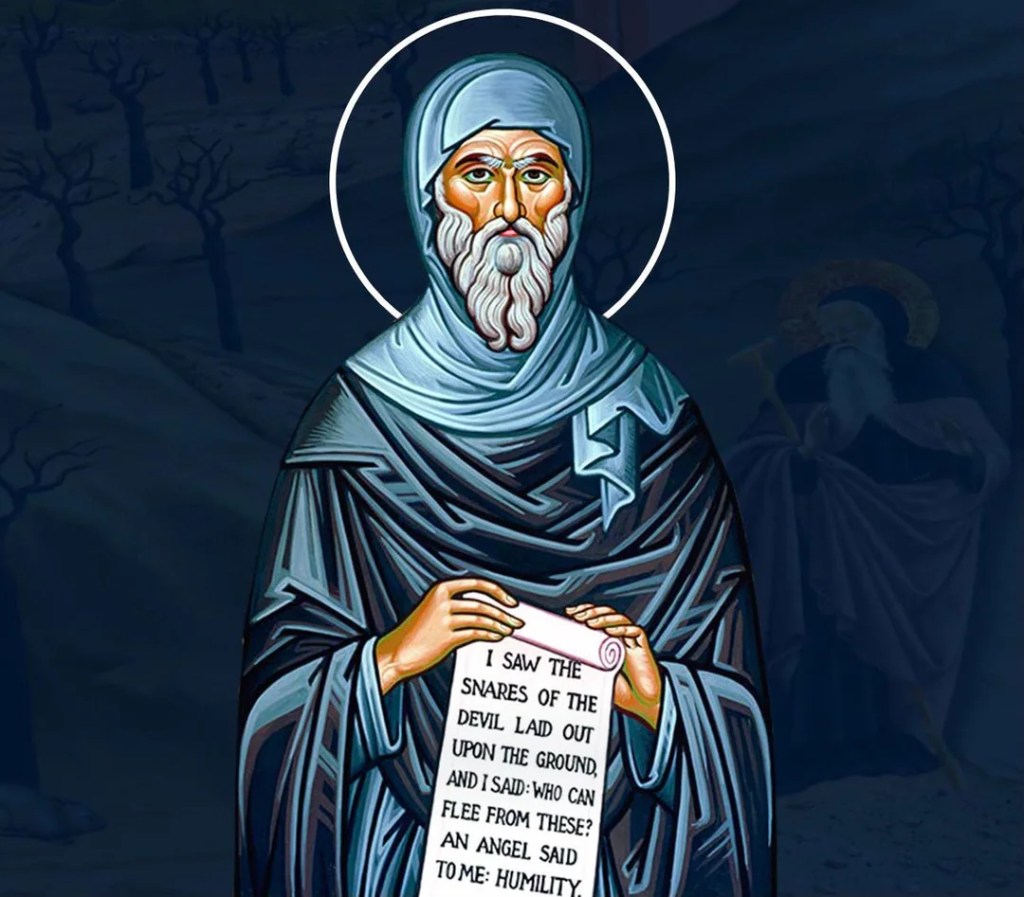
While the world says that people are the cause of our misery, St. Anthony the Great tells us this: “Our life and our death is with our neighbor. If we gain our brother, we have gained God, but if we scandalize our brother, we have sinned against Christ.” Likewise our Lord Himself tells us that “as you did unto the least of these, so you did unto me.”
Our brother is the image of God, and if we cannot truly love our brother than we will never love God. God allows us to face difficulties from our brothers and sisters so that, clinging to God and obeying the call to love, we might actually acquire love, and thus become like God. Being like God is a prerequisite to being close to Him, and God wants to be “equally yoked” with us in His love.
So Sarte not only speaks wrongly, but he speaks in a way that attacks the most fundamental aspect of God’s plan of salvation: the communion of the Church. The Church calls us to enter into communion, living for our brother and for God, having all things in common. This lifestyle of sacrificial love is an icon of the Trinity on Earth. Sarte calls us to put ourselves first, an image of one alone, dominating all around him. This is an icon of the devil.
So, Sarte’s atheism is evil, his view of his brother makes it worse, but of course the final blow is that he was a practitioner and promoter of pedophilia. One of the consequences of giving into our passions is that we start to see the world solely by our passions. Many people recognize their sin, despite not knowing how to overcome it, as was the case with Adam. However, some men genuinely love their evil and fight to present it as good, as with Cain. The product of the Fall is that, instead of seeing all things with Christ’s perspective, the infinite depth and beauty… we see Creation as a collection of objects, who’s only meaning and measure is how they are going to please us. This path leads to pedophilia.
Unfortunately, if we do not war with our passions as the Church prescribes, if we allow demonic thoughts of our brother to become our own beliefs, we will certainly be thrust down an evil path. If we want to oppose this evil, we must become men and women who are militant about the spiritual life. We must decide that we will no longer justify ourselves, as self justification culminates in all the blame being on everyone else but me.
The Saints say often that God cannot save the man who justifies himself. It is quite similar to the man who decides to defend himself in court. In justifying ourselves, we have made known to the Judge and the world, this is the explanation of our sins that we accept. The devil will easily turn these cases over as he has a lot of practice and, being without love, he keeps records of our wrong. He will shame us then like he stirs shame in us now. Or, we can accept everything as sent by God, and have Christ as our lawyer at the last judgement, and the Saints say He is biased towards saving us and will make a good case.
Thus, when we are annoyed, we must acknowledge God’s loving providence and say “this person was sent by God to show me my illness and draw me to repentance.” The alternative is to give into the same liar that Sarte listened to, who encourages us to focus on what we want and what we don’t have, and then uses this to make us miserable and to make us attack those we feel are responsible. Such a pattern culminates in a man who is all bitterness and pleasure, who rejects God and man on principle, and who is ready to commit the most atrocious evils, even celebrating like The Twilight Zone’s near-sighted man at mass death. This evil culmination also inaugurates an entrance into Hell, a place where everyone is a hungry beast, prowling about looking to devour each other. A man spends this life demanding to have a selfish world, and God gives it to him.

Let us ask ourselves: do we desire to bear the powerful love of Christ, or do we wish to become like Sarte and manifest the spirit of the devil? Let us choose peace, life, and heaven, treating every man as a brother sent by God with thanksgiving, repenting when we fail to live this, and constantly renewing our prayerful effort.
 Thaddeus Patrick